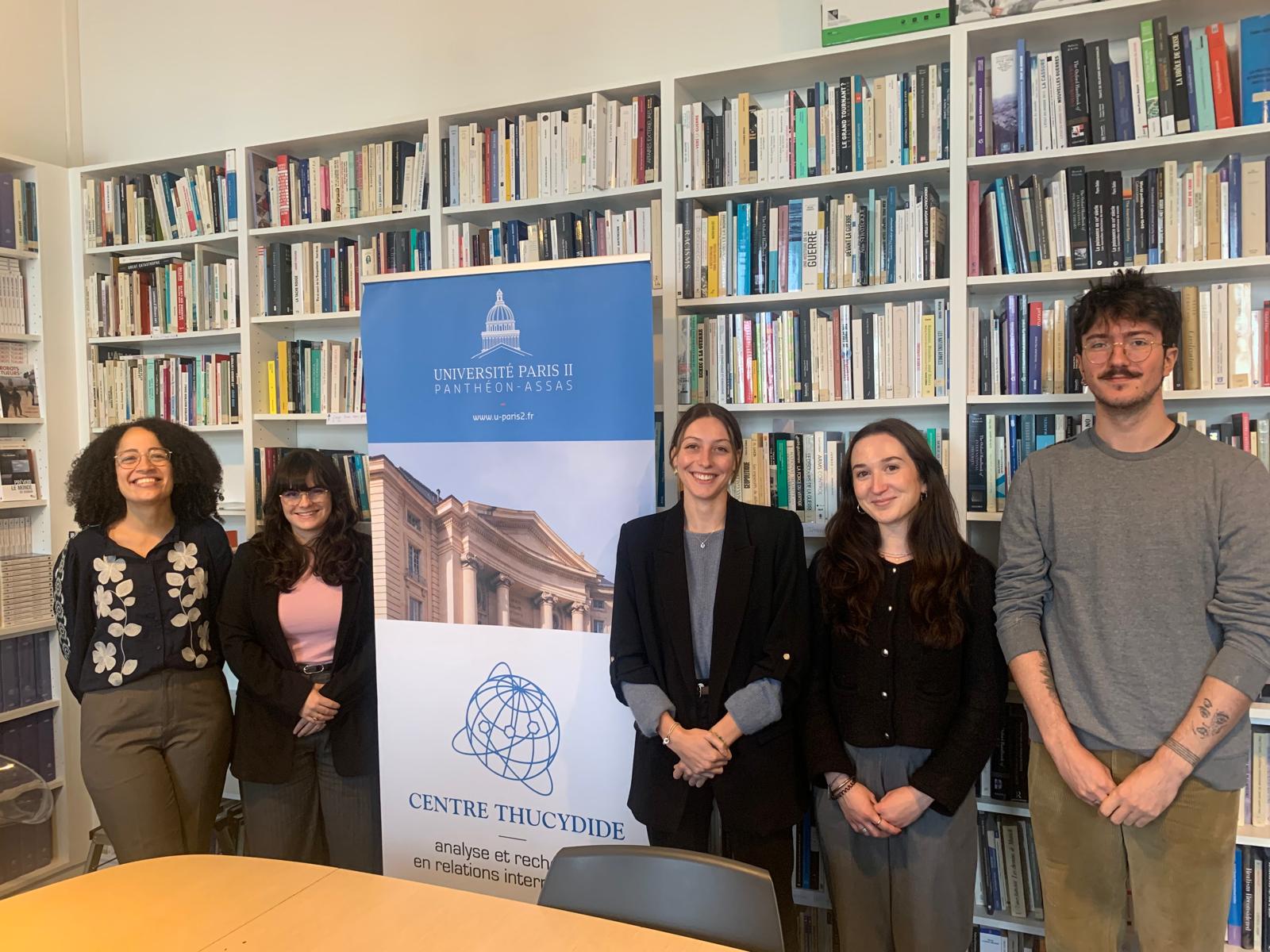
Under the responsability of Bernard Sitt

Under the responsability of Bernard Sitt

The Israeli nuclear armament

AFRI 2005, volume VI, 2005 par BIAD Abdelwahab
In spite of a politics of opacity, it is now doubtless that Israel possesses nuclear weapons. The Dimona reactor, built thanks to the French cooperation, lies at the core if the Israeli nuclear program, as Vanunu’s revelations to the Sunday Times in 1986 have confirmed. Contrary to other nuclear powers, Israel has not proceeded - or at least, not openly - to nuclear tests, nor confirmed its possession of the bomb, while denying its neighbours the right to acquire such a capacity. This (...)  lire suite

PSI : an advanced post in the fight against proliferation

AFRI 2005, volume VI, 2005 par DAHAN Paul
The fight against the proliferation of weapons of mass destruction (WMD) and their means of delivery is one of the most important areas of action for international peace and security. The traditional approach : multilateral disarmament and nonproliferation treaties - have an inherent limitation : non-compliance by some State Parties. The international community has therefore had to conceive of new ways to tackle proliferation issues. The new thinking is based on the following three axes : (...)  lire suite

The Iranian nuclear crisis

AFRI 2005, volume VI, 2005 par ERRERA Philippe
The nuclear crisis which started in the Summer 2002 saw the international community, Europeans in the lead, join forces to try to slow Iran’s progression on the path toward a nuclear military capability. The main obstacle Teheran encounters is the production of a sufficient quantity of fissile material. The issues at hand are considerable, whether it be for French and European security interests, for the credibility of multilateralism or for nuclear stability in the Middle East. Beyond the (...)  lire suite

Non-lethal arms

AFRI 2005, volume VI, 2005 par HUMAIR David, PERRON Christophe
For a number of years now, the battlefield has seen considerable change and, thanks to the media, is no longer a place ignored by all where anything is possible, especially the worst. Within this framework, the development and use of means designed to broaden the scope of options available to the combatant are justified. New non-lethal weapons - or technologies - therefore allow the soldier, to « dose » his response just like a police officer according to the intensity of the threat. (...)  lire suite

The new international context of security : a stake for the disarmament process

AFRI 2004, volume V, 2004 par SUR Serge
The disarmament process was greatly developed during the 20th century. It is now being covertly, or openly, questioned. The reasons include an increasing doubt about the effectiveness of disarmament instruments and mechanisms, new threats - whether governmental or non-governmental - against security, and a shift from confidence to mistrust in international relations. The protagonists react in diverse ways. The United States have an asymmetrical and mobile policy. The European States are (...)  lire suite

Disarmament : preserving the legacy and reviving the enterprise

AFRI 2004, volume V, 2004 par DAHAN Paul
In our world, international relations are characterised by an extraordinary volatility. This has prompted many to think about the future of arms control, disarmament and non-proliferation. Two paths lay before us, to be explored and, perhaps, approved. The first one consists in protecting the legacy through the current instruments’ enhanced efficiency : extending the authority of the norm and improving its implementation. The second path consists in reviving the enterprise of disarmament (...)  lire suite

The fight against weapons mass destruction is at a crossroads

AFRI 2004, volume V, 2004 par BIAD Abdelwahab
Today, the efficiency of weapons of mass destruction (WMD) non-proliferation regimes is compromised. The attacks on September 11th, 2001, have given more credit to the ghost of the terrorist menace using WMD, at the moment when the frontier between pacific and military uses of nuclear, bacteriological and chemical technologies is increasingly blurred. These attacks are invoked by the Bush administration to justify the questioning of arms control agreements and the adoption of a fight (...)  lire suite

The antipersonnel landmine dilemma

AFRI 2004, volume V, 2004 par MARQUES-GROSS Isabelle
While the arms control process reaches a pause, the antipersonnel landmine sphere, characterized since the 1980s by an inflation of rules, seems to be an exception. However, such a dynamic is due to the singular trajectory of a debate, likely to evolve in relation to its humanitarian grounds, enriched with a development dimension, rather than in relation with disarmament goals. Yet, the frontier between both these approaches tends at times to become blurred, involving two distinct dynamics (...)  lire suite

The Treaty on strategic offensive reductions and the new relations between

AFRI 2003, volume IV, 2003 par KLEIN Jean
In spite of reservations expressed by the Bush Administration against traditional arms control and the decision taken in December 2001 to withdraw from the ABM Treaty, negotiations between the United States and the Federation of Russia went on and led quickly to the conclusion of an agreement on strategic offensive arms reductions. According to the Treaty signed in Moscow, the 24th of May 2002, the two parties decided to reduce drastically their nuclear arsenal and to act in such a way that (...)  lire suite

A limited nuclear weapons-free zone in Northeast Asia : a tale of ten years

AFRI 2003, volume IV, 2003 par DUSCLAUD Michel, SIONNEAU Bernard
During the last half-century, several treaties were signed, that declared whole regions or territories of the world free of nuclear weapons. Northeast Asia does not fall into that category. Concerning the issue of nuclear disarmament, there is, however, a project for the area. Initiated by the CISTP of Georgia Tech, this project has been conducted since 1991 through informal channels (‘Track II ’ or unofficial undertaking) and has, thus far, materialised into a draft treaty. Meant to become (...)  lire suite
 
pages : 1 | 2

Centre Thucydide © 2008 | Mentions Légales | Contact Webmaster | Site réalisé avec SPIP