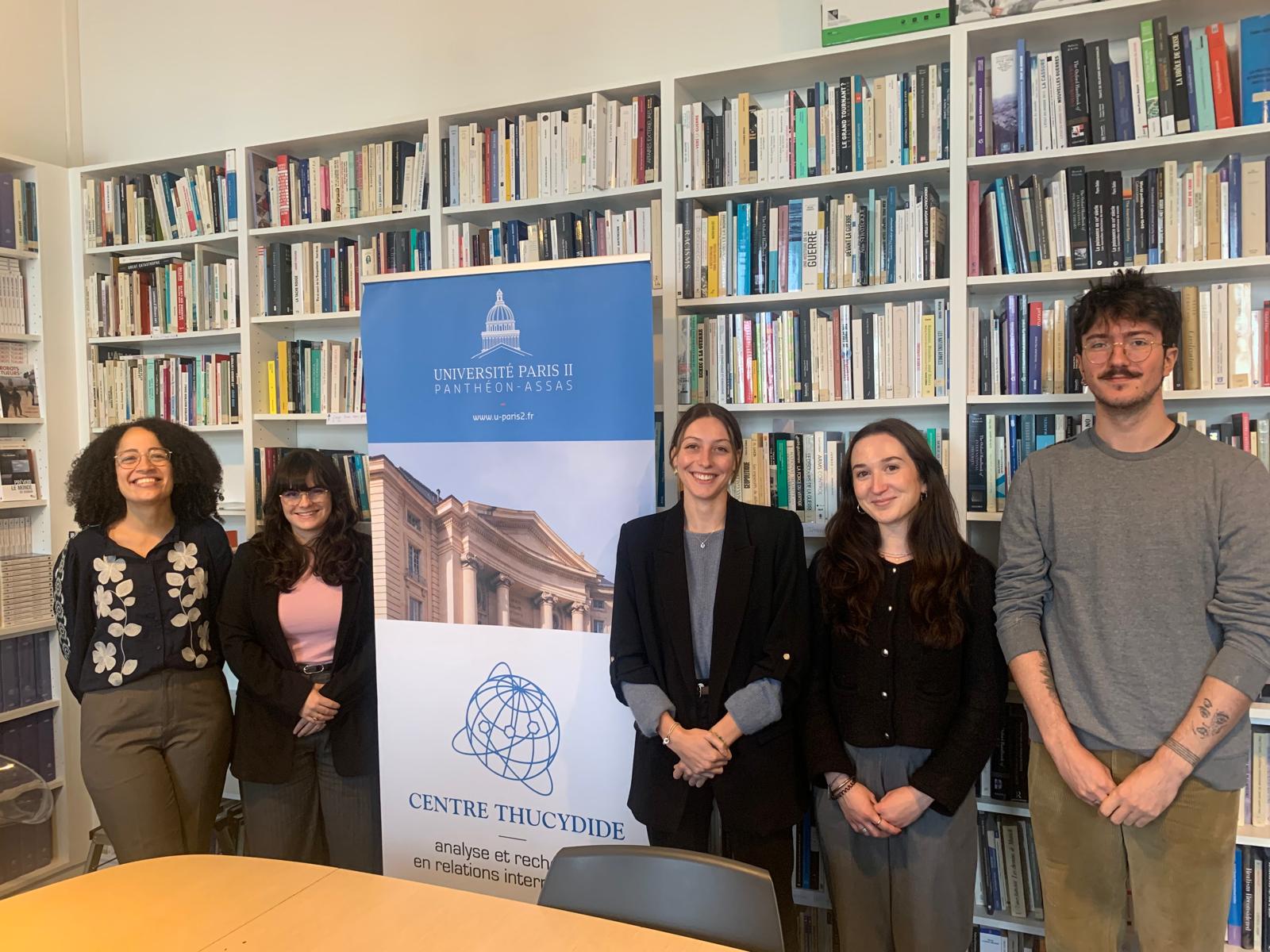
Under the responsability of Alexandra Novosseloff

Under the responsability of Alexandra Novosseloff

New international intervention in Haiti

AFRI 2005, volume VI, 2005 par JOUINEAU Sophie
Jean-Bertrand Aristide, the first democratically elected president in Haiti in 1990, abandoned the country on February 29, 2004 without completing his second term, in a grotesque replay of the worst authoritarian and violent practices in Haitian history. In order to establish minimum security for the transfer of power to an interim government, the UN authorized the immediate deployment of a multinational force, before taking charge itself in June, drawing upon Latin American human resources (...)  lire suite

Darfur : how are African crises managed ?

AFRI 2005, volume VI, 2005 par RICHE Elodie
The humanitarian consequences of the Darfur crisis have been high on the agenda of the media since the beginning of 2004. This crisis has also led to a diplomatic and military intervention of several international actors, through a complex and new observation and mediation mechanism. The African Union Mission in the Sudan (AMIS II), currently being reinforced, was rapidly deployed with the financial, logistics and political support of the European Union and of the United States. The Arab (...)  lire suite

Of the correct use of the reform of Palestinian institutions

AFRI 2005, volume VI, 2005 par TRÉGAN François-Xavier
Since September 2000, the reform of Palestinian institutions dominates the second Intifada. The Palestinian institutions’ failure to reform is alleged to be at the origin of the collapse of the peace process, and of the security built-up between the two main protagonists. The United States, in the aftermath of « September 11 », have relayed the Israeli analysis and spread that reform process to the entire Arab world. Far from only preparing the resuming of political talks between Israelis and (...)  lire suite

Mastering violence in the Ivory Coast Republic

AFRI 2004, volume V, 2004 par PATRY Jean-Jacques
The civil war that has been going on for a decade in Ivory Coast reached a climax in November 2002 when hundreds of former military soldiers and NCO attempted to strike a blow against President Gbagbo. On this occasion, the French armed forces deployed in the country to calm down the situation practiced a special doctrine called « Mastering violence operations ». Intervening as a third party between belligerents, the French forces defused the crisis escalation by denying the warring parties (...)  lire suite

Security stakes in Central Asia

AFRI 2004, volume V, 2004 par FACON Isabelle
After having held a secondary role in Russian foreign and security policies, post-soviet Central Asia has acquired an increasing importance in it, ever since Vladimir Putin came to power. This ‘renewal’ of Russia in Central Asia reflects the priority Moscow puts on reinforcing integration and cooperation within the Community of Independent States. It also betrays the perception of a greater emergency in regional security problems. A number of observers suppose that the Kremlin is trying to (...)  lire suite

The Israeli-Palestinian war : between risks of extension, mere exit from crisis and real peace opportunities

AFRI 2004, volume V, 2004 par ENCEL Frédéric
The violent clash between Israelis and Palestinian, since September 2000, is widely press-covered and spurs anxious reactions from Ministries of Foreign Affairs as well as average citizens, particularly in the West and the Arab world. However, it should not be taken for granted that this new, and alas, bloody confrontation stands for the so-called Middle East Œpower keg¹. After three years, the second Intifada has not triggered off any new disruption in the region, although the risk for a (...)  lire suite

Rational or reasonable ? The project of an impending military intervention

AFRI 2003, volume IV, 2003 par SUR Serge
Firstly, it is necessary to distinguish between rationality and reasonableness, as well as several kinds of levels of rationality - true to life or rebuilt, subjective or objective, actual or apparent, political or legal... Second, such criteria have to be applied for the analysis of the American project for an early military intervention against Iraq - through the identity of the actor or the actors of such an intervention ; through its motives, visible or secret ; through its goals, (...)  lire suite

Foreign policy in Putin’s Russia

AFRI 2003, volume IV, 2003 par FACON Isabelle
Since Vladimir Putin became Russia’s president in April 2000, the country’s foreign policy has become more pragmatic. Aimed primarily at meeting Russia’s economic interests, it emphasises dialogue rather than confrontation, and achieving realistic goals rather than stating unrealistic ambitions. In this new framework, downgrading the weight of the « US factor » in Russia’s diplomatic efforts has been considered as a necessity. However, these changes, deemed as positive by Moscow’s Western (...)  lire suite

Russia’s military expenditures at the beginning of the 21st century

AFRI 2003, volume IV, 2003 par FONTANEL Jacques
This essay presents the evolution of the Russian military budget since the end of USSR, by comparing official data with those supplied by different Western organizations (IMF, SIPRI, ISS...). Thus, various problems concerning the estimates of Russian military expenditures are discussed, as well as the lack of a clear definition of the content of military expenditures, the culture of secrecy and the traditional use of statistics for political purposes. The Russian statistics of military (...)  lire suite

Civil Society and Conflict Resolution in West Africa

AFRI 2002, volume III, 2002 par AYISSI Anatole
In the last decade of the 20th century, a new kind of armed conflict has emerged in West Africa, consisting in chaotic battles, with no clearly defined political agenda, in which it is hard to distinguish between combatants and non-combatants and where the main victims are civilians. Facing these transformations in the scope and the nature of violence, preventive diplomacy, in the classical sense of the term, remains confused and powerless. Consequently, societies, states and multilateral (...)  lire suite
 
pages : 1 | 2

Centre Thucydide © 2008 | Mentions Légales | Contact Webmaster | Site réalisé avec SPIP